Participate in NISO
All of the work that takes place at NISO involves the contributions of dedicated volunteers, who assist the community through their engagement. There are many ways that members and non-members can participate. You could serve on a technical working group, help organize educational events, or participate in NISO's organizational leadership.

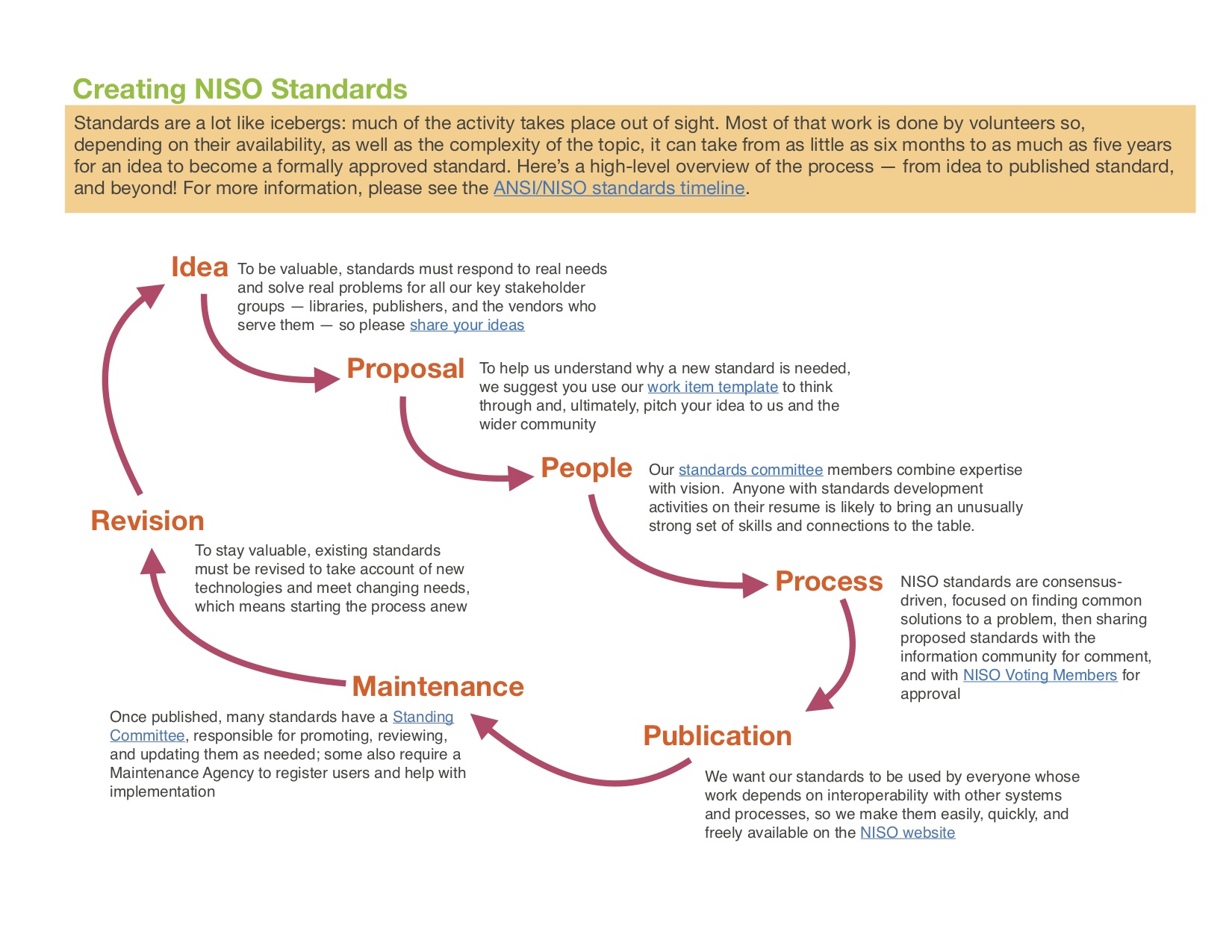
Creating NISO Standards
How Standards are Created
Standards are much like icebergs: a lot goes on under the
surface, beyond your immediate view. Typically a standard
is "supported" by years of development and trial
implementations. It can take up to five years for a good idea
to advance to being a formally approved standard. You can
track the progress of our standards through the standards
development pipeline.
Before they become standards, they are good ideas:
There may have been a day when standards could be academic exercises,
but no more. Change is ubiquitous. Some would say that change has
become the only constant in our lives -- personal and professional.
Standards can be vehicles that allow us to move through periods
of transition, but they must respond to real needs and solve real
problems to be used, otherwise they are "shelf-sitters".
To develop market driven standards, NISO needs to hear from you
and be a good listener.
So NISO learns more about a good idea:
That is why NISO sponsors pre-standardization workshops that
bring together expert industry representatives to talk standards for a
day. It happens because leaders in an industry recognize a problem
and work together toward a solution. The result is a report with
recommendations. And very often, the recommendation may suggest that a
standards committee be formed. Topics NISO has begun to address include the
implementation of the DOI, standards for machine-generated thesauris,
library statistics for the Internet age, and networked reference
services.
Then a committee gets to work:
Standards development is a challenging activity unlike any other
professional endeavor you may undertake. It demands a commitment
of time and expertise and intelligence that is not unlike basic
research and development. It is definitely not for the weak of heart
or mind! Standards committee members require technical expertise
combined with vision. In the case of the committee chair communication
skills and interpersonal skills are a must. The process may be tedious
at times, it may tax your patience, but it will never bore you.
If you spot standards development activities on a job candidate's
resume you can be assured that individual brings an unusually capable
set of skills and connections to the table.
And the community gets involved:
Shaping good standards takes time but this investment is not any
longer than other important strategic activities your organization engages
in. The fact is, standards are a product of consensus which requires
significant base-building that must go on to move a group to a common
solution. This investment is the most important part of the process
and its value cannot be downplayed. Drafts of proposed standards are submitted
to Voting Members of NISO for comments and approval and available to any
involved party for comment.
Approved standards are published and used:
When a standard is published, NISO announces this as widely as possible
through a variety of electronic lists, to many industry news outlets,
and on our web site. Because we want people to use these standards,
we also make them easily, quickly and freely available for download for free
from the NISO website. NISO standards are used by publishers and information
providers, automated information systems companies, library directors,
systems librarians, serials librarians, preservation librarians,
abstractors, indexers-all those whose work depends on interoperability
with other systems and processes.
But it's still not done:
Some NISO standards require a Maintenance Agency to register users,
to assist in implementation of the standard and to provide information
on any changes to the standard and advise on how to implement the
standard. And all standards are reviewed on a regular basis at least five years after approval and
revised as the information environment changes.